

Board exams can appear to be stressful for students at some point. The syllabus is lengthy. Every chapter appears important. Time passes very quickly as the exams approach.
The common mistake that most students commit at this stage is that they begin studying from scratch all over again.
However, revision has nothing to do with increased reading. It has everything to do with memorisation, pinpointing weaknesses and being ready to learn all the time.
The right revision strategies for board exams can help in organising one’s knowledge and practising to enter the exam room confidently.
Why is Revision Important for Board Exams?
Revising is a process which will allow you to convert your acquired knowledge into something that can be recalled whenever it is necessary.
Strengthens Understanding of Concepts
You will find some points to be unclear when going through the same chapter again.
Through revision, you will be able to understand better and clarify all doubts.
Improves Memory and Recall
There will be some things that you are likely to forget after studying.
Going through the process of active recall will allow you to reinforce the knowledge and make it easier to recall during exams.
Builds Exam Confidence
Confidence grows by becoming familiar with a particular subject.
Through constant revision and practice, you will be more likely to say, “I know how to do it” rather than panic.
- Create a Board Exam Revision Plan
Do not just go about revising randomly.
A systematic exam revision plan will help you know what to revise and how much time should be spent on each subject.
(I) Make a Subject-Wise Revision List
Write down all subjects along with their important chapters included in the syllabus.
Mark each topic as “revised”, “partially revised”, and “not revised” to give you a better picture of how to revise.
(II) Prioritise Difficult Topics
Don’t spend too much time revising those chapters which you already know.
Devote more time to those topics that are difficult for you or those in which you make mistakes.
(III) Set Daily Revision Goals
Set very specific goals for your revision process.
It’s better to write “Revise quadratic equations and solve 15 questions” rather than “Revise Maths”.
Clear goals will help you see the progress.
- Use Active Revision Techniques
Repeatedly reading the same notes will make a topic seem familiar to you without actually understanding it.
(I) Practise Self-Testing
Close your books and ask yourself questions.
Test yourself by writing formulas, definitions or explanations without referring to your notes.
Self-testing is important since it requires recall rather than recognition.
(II) Solve Practice Questions
Solving questions will help you understand if you can apply what you have learned without looking at your notes.
Also, it will give you a clue about the topics to revise.
(III) Explain Concepts in Your Own Words
Try explaining the topic as if teaching it to someone else.
If you can’t explain it simply, you should revisit the idea once again.
- Make Short and Useful Revision Notes
Revision notes should assist you and definitely not be just another textbook.
(I) Focus on Important Information
Note down formulae, definitions, dates, key terms, diagrams, steps, and difficult facts.
Make sure that language is concise and scannable.
(II) Use Tables and Mind Maps
Use tables for comparing information and mind maps for linking ideas.
Select whatever method makes you remember quicker.
- Practise Previous Year Question Papers
Old question papers are among the most helpful sources for revision of board exams.
(I) Understand the Question Pattern
Notice how questions are formulated, the frequent appearance of chapters, and the distribution of marks.
This will allow you to get familiar with the type of questions.
(II) Practise Under Exam Conditions
Solve the question paper sitting in a quiet room under time restrictions and without having access to notes.
This way, you will practice answering the questions as well as managing time.
(III) Analyse Your Mistakes
Do not end your work by checking your score.
Analyse every wrong answer and ask yourself why you made that mistake. Your errors can be a key to further revision.
- Take Mock Tests Regularly
Mock tests will help you check your preparation for the actual exam.
(I) Follow the Time Limit
Try to do each mock test within the time frame of the actual exam.
It will give you an idea of the time required for different parts of the paper.
(II) Track Your Progress
Compare your performance from one mock test to another.
Accuracy, speed, and areas of improvement should be considered. Poor performance in one test will point out the field which requires your attention.
- Use Spaced Revision for Better Retention
Studying the whole subject in one day may seem like a good use of time, but revising it in different sittings will help you memorise it.
(I) Revise New Topics First
After a few days, try to go back to the topic that you have recently learned.
It will help you revise the chapter properly and retain what you have learned.
(II) Revisit Difficult Topics Regularly
The difficult chapters might require many revision sessions.
It will be better to revise them in smaller intervals instead of long study periods.
- Balance Revision With Breaks and Rest
Revision is most effective when you aren’t mentally tired.
(I) Take Short Breaks
Take a break after you have studied the material thoroughly.
You can take a small walk, stretch yourself or have something to drink before getting back to it.
(II) Get Adequate Sleep
Never make a habit of late-night studying.
A relaxed mind is able to concentrate and remember things more effectively than a tired mind.
- Manage Time During the Final Revision
With the approach of exams, revision should become increasingly focused.
(I) Focus on High-Priority Topics
Spending more time on important topics, formulas, frequently tested concepts and problem areas in the subject will be helpful.
It is unnecessary to revise everything equally.
(II) Avoid Starting Too Many New Topics
During the final days of preparation, the focus should shift to consolidating what one knows.
If there is an important topic left out of your revision programme, you can cover it, but you should not add too much new content.
- Avoid Common Revision Mistakes
Even hard-working students tend to waste time as a result of an inefficient revision process.
(I) Avoid Last-Minute Cramming
You cannot revise the whole syllabus during the last few days.
Short and regular revision sessions are better than memorising everything during one session.
(II) Avoid Passive Reading
Do not limit your revision to revisiting highlighted parts.
Revise without opening the textbook, recalling information, solving questions and writing answers.
(III) Do Not Ignore Weak Subjects
It is quite natural to spend more time on your favourite subjects.
However, subjects you find difficult might require more attention, so you should include them in your exam revision plan.
(IV) Do Not Compare Your Preparation With Others
Your friend might complete the syllabus before you.
Someone else might boast about studying ten hours a day.
It is unnecessary to panic about such things.
Revision Strategy for the Last Week Before Board Exams
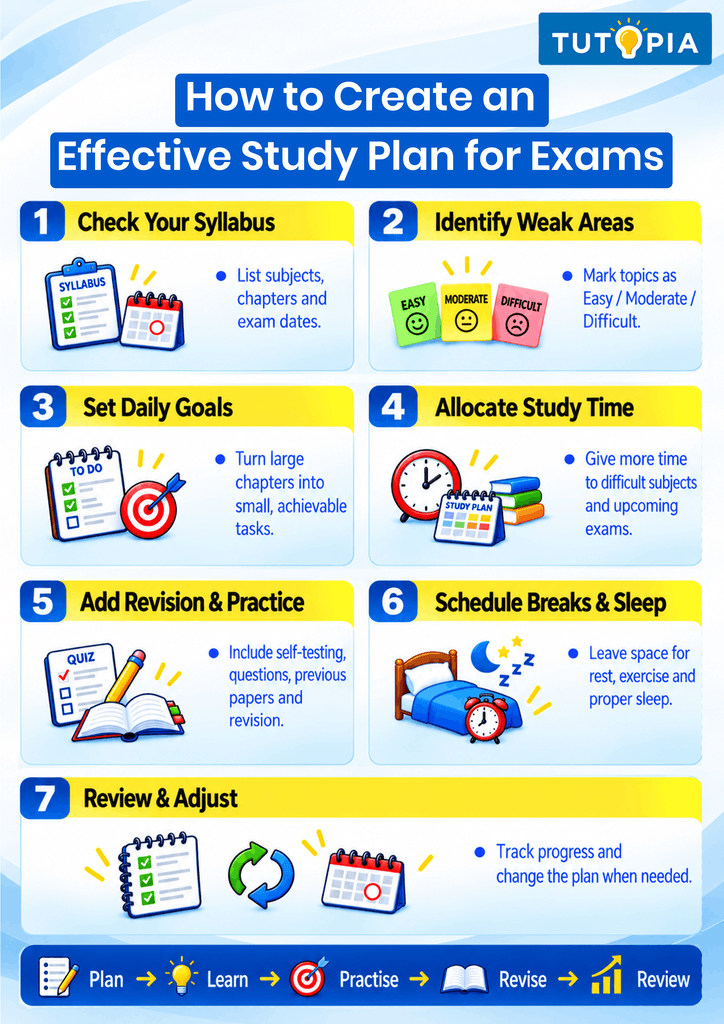
The last week should definitely not cause any stress for you. But it should help you improve your preparations.
(I) Review Important Concepts and Formulas
Cover formulas, notes, definitions, dates, diagrams, and difficult concepts.
Work on the topics which you still forget.
(II) Solve Sample or Previous Papers
Write some timed papers and analyse them after.
This way you will be able to practice your writing as well as to see what your readiness level is.
(III) Maintain a Healthy Routine
Eat right, drink enough water, have breaks and go to bed at regular hours.
Even your brain needs some energy.
Effective Revision Strategy on the Day Before an Exam
The day before your exam is not the day to cover all material once again.
Be light in your preparations.
(I) Review Key Points
Cover formulas, definitions, short notes, diagrams, and difficult issues.
Do not open your book for reading if you do not need to.
(II) Prepare Your Exam Materials
Have your admit card, stationery, your school ID, a bottle of water and other things ready beforehand.
One less thing to worry about in the morning.
(III) Get Enough Sleep
Do not stay up at night just to read one more chapter.
You have already done the job.
How Tutopia Can Help
You don’t have to prepare for your board exams all by yourself.
Tutopia will help you go through an easy learning process:
Learn → Understand → Practise → Revise
Facing problems with tough topics or confused about your exam preparations? Regardless of whether you are facing trouble with any hard concept, need practice with some questions or need revision for any important chapter, Tutopia will surely help you go through this in a more organised way.
Using Tutopia SWIFT, you can revise key topics with animated video tutorials, take mock tests, and improve your weaker areas to appear for your board exams with confidence.
Final Thoughts
Do you know what the best revision strategies for board exams are? It is not studying all day long. This involves revising the correct areas, self-testing, practising questions, learning from your mistakes, and going over difficult areas again and again.
There will certainly be times when you get anxious about an exam or wonder if you have prepared enough. This is perfectly natural.
- Follow your exam revision plan.
- Apply proper revision techniques.
- Take care of yourself.
- Concentrate more on making steady progress rather than achieving perfection.
Any more help needed? In such cases, Tutopia SWIFT will help you learn and revise efficiently.