



Some students work hard for hours but still feel unprepared, while some sit with their textbooks but keep getting distracted every few minutes. Sometimes, the problem is not laziness but an ineffective study routine.
Good study habits for students are all about making the learning process more manageable daily. These habits can help students stay organised, remember what they learn, reduce stress, and feel more confident.
The best thing about these good study habits is that you don’t need to form them instantly but rather gradually through regular practice.
Why Are Good Study Habits Important for Students?
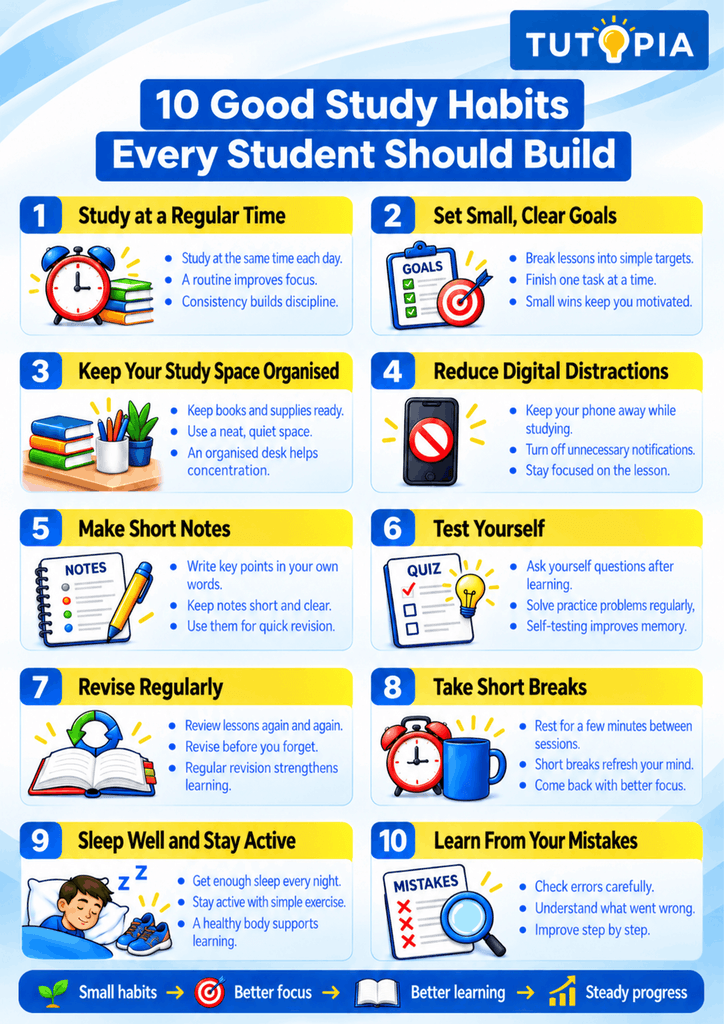
Effective study habits can make learning more organised and manageable.
(I) Improve Concentration
If you always study at a particular time of day and in a particular location, it will become easier to focus on your work.
(II) Improve Time Management
A proper study schedule will help you determine priorities and allocate the appropriate amount of time. This can improve student productivity and prevent the feeling that there is too much work to do.
(III) Reduce Exam-Time Stress
Those who revise regularly will not need to revise at the last minute. With regular studying, one can get more chances to comprehend complicated material, perform different assignments, and revise important information.
(IV) Create a Consistent Study Routine
A routine brings structure into your life and makes studying easier.
- Set a Regular Study Time
Select the time during which you are likely to concentrate better. It can be after taking a break from classes or in the evening. The exact time matters less than following the routine consistently.
- Start With Small Study Sessions
You shouldn’t start your studying with the attempt to sit and revise material for hours. Begin with smaller, concentrated sessions and gradually increase the time.
(V) Set Clear and Achievable Study Goals
Reading without a clear goal can waste valuable study time.
- Set Daily Learning Goals
Instead of setting a goal like “study science”, it is better to set a specific goal, such as “read one chapter and solve ten problems”.
- Break Large Tasks Into Smaller Steps
Reading one chapter of science can be an uphill task. To make things simpler, one must divide the chapter into parts and solve it in small portions.
(V) Create a Distraction-Free Study Environment
Sometimes the right atmosphere can help a lot.
- Keep Study Materials Organised
All your books, notebooks, stationery, and other notes should be arranged in one particular place.
This will save time and make it easier to start studying.
- Minimise Digital Distractions
Social media posts, phone messages, and other digital content can distract from studying.
One should keep these distractions away when starting their study sessions.
(VI) Learn to Take Effective Notes
Good note-taking will allow you to revise easily and quickly.
- Write Important Points in Your Own Words
Instead of copying all the sentences in the textbook, write down the key points using simple sentences. Writing the notes in your own words allows you to see if you have understood them well enough.
- Highlight Key Information
Highlight the formulas, definitions, dates, keywords and examples. Do not highlight whole pages, as the goal is to make the most useful information stand out.
(VII) Use Active Learning Techniques
Simply reading can make a topic feel familiar without showing whether you can actually remember or use what you have learned. Active learning gives you a better way to check your understanding.
- Practise Self-Testing
Take your books away and test yourself by asking questions about what you have just read. See if you can answer the question before looking at your notes.
- Solve Practice Questions
Questions are useful since they demonstrate how certain concepts are applied and help to spot topics which need more revision before exams.
© Explain Concepts in Your Own Words
Try to teach someone what you have read about as if you were their teacher. If you have problems explaining it, go back and revise the concept.
(VIII) Make Revision a Regular Habit
Revision works best when it is part of your regular study routine, not something left until the last few days.
- Review Lessons Regularly
It would be beneficial to go back to some old chapters after a couple of days instead of waiting for a long time to pass. Going back to the topics frequently can make it easy to remember them later.
- Maintain Short Revision Notes
It would be good to have short notes of all formulas, dates, concepts, diagrams, and summaries. These can prove useful during exams.
(IX) Take Regular Breaks
Studying for longer does not always mean studying more effectively.
- Use Short Breaks Between Study Sessions
Once you finish working on something, you should take a short break to drink water or have some rest. You can then return to your next assignment.
- Avoid Turning Breaks Into Long Distractions
A quick phone break can easily turn into thirty minutes of scrolling. It is best to set up a time limit and return to your studying after that.
(X) Maintain Healthy Lifestyle Habits
Effective studying also depends on taking care of your health.
- Get Enough Sleep
Enough sleep will help students stay attentive during classes. You should try not to make staying awake at night your constant practice, especially during examination preparation.
- Eat Healthy Meals
Regular meals help students stay energised during school and study time. Not eating on time may hamper concentration.
© Stay Physically Active
Walking, exercising, playing a sport, or stretching gives the body a break from sitting for long periods.
(XI) Avoid Procrastination
Everyone puts things off sometimes. The important thing is learning how to get started.
- Start With the Most Important Task
If there is an urgent assignment or chapter which requires immediate attention, do not postpone starting work on it yet again. Getting started is often the hardest part.
- Use a Simple To-Do List
Write down a few tasks for the day that could realistically be completed. Checking them off could help you feel like you have made some progress.
(XII) Learn From Mistakes
Mistakes do not mean that a student is weak. They are just the places where more practice is required.
- Review Incorrect Answers
Go through your mistakes in homework assignments, tests and practice exams. Understand why this answer is wrong to move on.
- Focus on Improvement
Rather than saying to yourself, “I am poor at this subject,” you should ask, “How can I do things differently the next time?”
(XIII) Stay Consistent Instead of Seeking Perfection
An efficient study regime is not about getting everything right every day.
- Get Back on Track After a Missed Day
There are going to be days when things are hectic, exhausting, or unproductive. Missing one day does not mean your routine has failed. Simply get back to it the next day.
- Make Gradual Improvements
Try improving one thing at a time. You may start with your study times, revision, note-taking, or reduced phone usage.
Common Study Habits Students Should Avoid
Some methods might seem simple, but they will make you study worse.
Avoid Last-Minute Cramming
Last-minute studying may cause extra stress and difficulties with memorising.
Avoid Studying With Constant Distractions
Getting distracted by messaging or videos does not allow one to concentrate properly. One should try to devote their full attention to the task when it is possible.
Avoid Skipping Revision
Studying a chapter once is not enough. Regular revision helps you retain what you have learned.
Avoid Comparing Your Progress With Others
One student may learn quickly while another needs more time. Focus on your own progress rather than someone else’s routine or marks.
Age-Specific Study Strategies
Study habits, too, must transform as the individual grows and becomes more independent.
For Younger Students
Younger students can focus on building simple routines. Short study sessions, regular reading, organised schoolwork, and breaks can help them develop consistency without feeling overwhelmed.
For Middle-School Students
Middle-school students can start taking more responsibility for their own schedules. Setting goals, making notes, practising questions, and tracking their work can help them become more independent learners.
For Class 9 and 10 Students
Students in Classes 9 and 10 may need a more structured study routine, especially when preparing for important school or board examinations. They should give extra attention to difficult subjects, practise questions regularly, revise older chapters, and use sample papers or mock tests to check their preparation.
Simple Daily Routine for Building Good Study Habits
The following is a possible schedule for such a student:
4:30 pm: Relax and enjoy some snacks.
5:00 pm: Study a difficult subject.
5:45 pm: Break period.
6:00 pm: Do homework or questions.
6:45 pm: Free time.
8:00 pm: Revise an older topic.
8:30 pm: Note-taking and self-test.
9:00 pm: Planning for the next day’s work.
It is just an example, and one must modify it according to their school time, age, subjects, and energy level.
How Tutopia Can Support You
Sometimes, one finds a chapter tough to comprehend. At times, students may even find themselves unable to recall what they studied the previous day. Developing effective study habits becomes easy when one has the right resources and a proper learning routine to follow.
At Tutopia, students can create a better way of studying through a four-step process which includes:
Learn → Understand → Practise → Revise
Learning resources provided by Tutopia allow students to utilise their time efficiently during their study routine:
- Practice Questions and Online Mock Tests: Testing your understanding level for the subject and highlighting the areas that need improvement.
- Tutopia SWIFT: Making revision easy before exams by going through the topics that need revision.
- Learning Spoken English: Enhancing skills of listening, speaking, reading, and writing.
There is no need for you to revamp all your study strategies overnight. All that you need is to focus on learning at least one tough concept, attempt some questions, and revise the chapter that you studied the previous week.
Along with Tutopia, this small effort will transform into good study practices, good understanding, and confidence during each and every exam that comes along.
Study effectively using concept-based video lectures and revision with the help of Tutopia SWIFT. Create a schedule that is best suited to you and study those difficult chapters confidently with the help of Tutopia.
Start your journey with Tutopia and take a step towards good study practices!
Final Thoughts
Good study habits for students do not require them to study all their free time. The main point is proper time management, active learning, revision, and a healthy mind and body.
It is expected that there are days when it is hard to concentrate or when something changes your schedule. It is important to get on track again, to make improvements and to continue.
With time, patience and consistency, good study habits can improve self-confidence and student productivity.