

During exam times, the mood at home usually changes. Children may become quiet, anxious or irritable, while parents begin worrying about unfinished chapters, revision, marks and whether their child is studying enough.
However, during this period of time, children require much more than just studies and study tables. What they require is assurance, patience, motivation and the presence of their parents by their side.
Good exam preparation for students is not about studying for endless hours. It is about having a sensible plan, revising regularly, managing stress and knowing when to ask for support.
Why Parental Support Matters During Exam Preparation
Examinations generate fear, self-doubt and pressure. Children feel immense pressure, as it seems that everyone’s expectations are placed on them. At times, a child might be thorough in the subject yet apprehensive about answering the question paper.
The parents are there to act as the source of support at this time. A calming talk, some motivation, or just hearing someone out may work better than extra hours spent on studies.
(I) Build Confidence Through Encouragement
Some supportive words can really make a lot of difference.
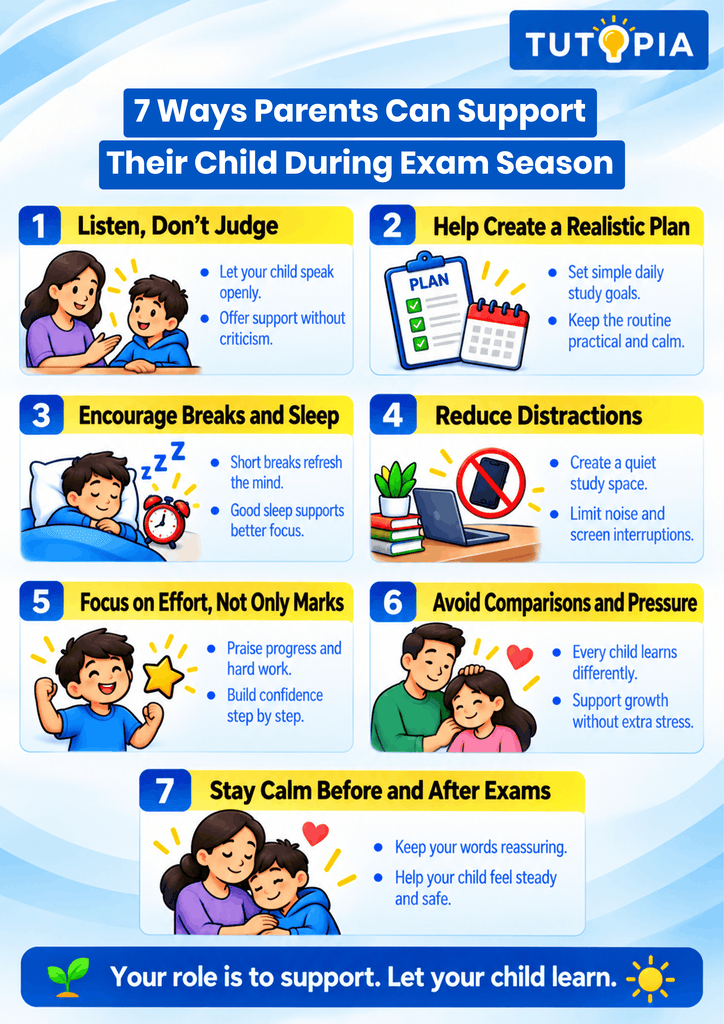
Instead of saying, “You are far away from being prepared,” say, “You have done well so far. Let us find out what we can accomplish further.”
Let your child know that you notice their effort and progress. Appreciation encourages them to study.
(II) Avoid Comparing Your Child With Others
Children learn in different ways. While one might excel in mathematics, another might be more competent with languages and sciences.
Comparing your child to their fellow students, relatives, or peers makes them feel as if they do not put in enough effort. Make them concentrate on what they have achieved.
- Help Your Child Create a Realistic Study Plan
The heavy syllabus may seem terrifying when looked at as a whole. But a straightforward and practical approach can make it seem less intimidating.
(I) Divide the Syllabus Into Smaller Goals
Rather than asking your child to study something like ‘science’, make sure to set them a small but realistic goal, like studying a single chapter and answering ten questions.
Small, achievable goals help children see their progress, and that can make a large syllabus feel much less frightening.
(II) Include Revision and Practice
Learning a chapter in one go is one of the poor study habits for students. The best approach will include revision, answering some questions, and taking old year papers and mock test papers.
It is particularly necessary when it comes to board exam preparation, where knowing the subject alone is insufficient.
- Create a Comfortable Study Environment
Children don’t require an ideal study environment but rather one that is moderately quiet and comfortable enough for them to focus without distractions all the time.
(I) Reduce Distractions
Television, loud talking, messages, and constant phone calls might be easily distracting.
Parents should be able to create quiet times for studying and promote responsible phone use without making distractions disappear altogether.
(II) Let Your Child Take Ownership
Parents will always want to check whether everything is going fine. However, continuous checking may cause additional pressure.
In order not to decide on everything yourself, you should ask, “What would you like to complete today?”
Such a simple step could foster responsibility and help develop better study habits for students.
- Encourage Healthy Study Habits
Additional time spent does not necessarily equate to additional preparation. An exhausted and stressed student may find himself spending hours with his book without grasping anything.
(I) Prioritise Adequate Sleep
Staying up all night may seem like a productive activity, especially when exams approach. However, sufficient sleep is necessary for mental alertness and focus.
Instruct your children on the need to sleep sufficiently, especially in the days preceding exams.
(II) Include Regular Breaks
Sitting through several hours straight for revision may be too draining for the brain of the students. Taking a break from time to time to relax helps the student get back to revising.
- Help Your Child Manage Exam Stress
It’s normal for a person to feel nervous about taking an exam. However, if that nervousness begins interfering with sleep, eating, concentration, and self-confidence, then children may require extra help.
(I) Listen Without Judging
When your child says, “I am scared of this exam,” do not immediately respond by saying, “There is nothing to worry about.”
Listen first.
Find out what is causing their anxiety. At times, your children might just need a practical solution, while at other times, they might just need someone who will listen to them without being judgemental.
(II) Recognise Signs of Excessive Stress
Be aware of major signs such as excessive crying, irritability, insomnia, poor appetite, or disinterest in studying.
If stress becomes too much to handle, then talking to teachers or even a counsellor might help.
- Focus on Effort Rather Than Only Results
Marks matter, but it is important that the child does not feel that marks are the sole focus for his/her parents.
(I) Praise the Learning Process
Rather than asking, “How much do you think you will score?”, pay attention to the work put in by him/her.
- “You have worked very hard on that chapter.”
- “You have improved your practice test score.”
- “You did not quit on that tough subject.”
These small things may make a world of difference to the child.
(II) Set Realistic Expectations
Expecting high standards from the students can help in motivating them, but expecting too much may impact student performance.
Think about what your child’s strengths and weaknesses are and set expectations accordingly.
- Be Supportive Without Becoming Overprotective
Parents always try to protect their children from any kind of failure. However, children must also be given an opportunity to learn how to prepare on their own.
(I) Avoid Constantly Checking Progress
If you keep asking, “How much have you done?” all the time, your child may feel like he or she is being monitored.
Pick a proper moment for checking and leave some time for studying.
(II) Help When Your Child Needs You
Be ready to assist your child when it is needed. Help in organising notes, finding study material, practising questions or just being supportive after a hard study session.
Keep in mind that parents do not have to become teachers for their children. Your role is to support the learning process, not carry the entire responsibility for it.
What Parents Should Avoid During Exam Season
Often, parents end up exerting undue pressure on children without realising it. There are certain practices that must be avoided at any cost.
(I) Avoid Comparisons
Do not compare your child with toppers, friends, cousins or even siblings. Any sort of comparison will make a child think that his own efforts fall short.
(II) Avoid Excessive Pressure
Make sure you don’t give your children the impression that one exam will shape their destiny.
The right parental guidance is to tell them to focus on their studies seriously, but also tell them that one exam cannot determine their intelligence, capabilities and self-worth.
(III) Avoid Encouraging All-Night Study
Although all-night studying seems like an emergency situation sometimes, it is better to prepare and revise throughout, eat properly and sleep well.
How Parents Can Support Children on Exam Day
Exam day should be as relaxed as possible.
(I) Prepare Everything in Advance
Have the admit card, stationery, uniform, water bottle and other things ready the previous night.
Some minutes of preparation can save a lot of stress on that day.
(II) Create a Calm Morning Routine
Don’t begin your morning with, “Have you revised everything?”
Your child should wake up on time, have breakfast, dress up and reach the examination hall without any rush.
(III) Give Positive Reassurance
Before your child leaves, give him/her these simple words: “Be calm, read the questions properly and do your best.”
Sometimes, these simple words can be a lot for a nervous child.
What Parents Should Do After the Exam
What happens after the exam matters too.
(I) Give Your Child Time to Relax
Do not ask right away, “How many marks will you score?”
Allow your child time to relax, have something to eat, and take some distance from the test. If the test was hard, he/she may need comfort rather than a quick analysis of all answers.
(II) Encourage Them to Focus on the Next Exam
If there is another one, help your child to shift his/her focus to it. Repeatedly talking about the mistakes made at the previous exam may raise anxiety levels.
Encourage him/her to learn from this experience and prepare for the next one.
How Tutopia Can Support Your Child’s Preparation
When you are a parent, it is not easy to see your child struggling with a chapter, losing confidence because of a bad test score, and worrying about the upcoming test. You want to help them but lack the time or knowledge to teach them everything. It is alright; you do not need to be their tutor to help them.
With the help of Tutopia, your child’s learning process will become simpler, while you can spend your time doing other things and focusing on what is really important: your child.
Using Tutopia’s learning tools, your child will be able to:
- Understand Difficult Concepts: Video lessons and real-life examples will help your child understand difficult concepts.
- Adopt Revision Practice: Tutor Smart Notes will allow your child to revise concepts without revisiting the whole chapter.
- Get Practice and Gain Confidence: Practice questions and online tests will help them find their weak spots and become more confident with exam questions.
- Get Better Prepared for Exams: Tutopia SWIFT offers students effective revision and allows them to revise their key topics and get some practice ahead of the board exam.
- Become Self-Motivated Learners: Access to easy learning resources makes children responsible for their studies and motivates them to learn in an organised way.
Let your child go through a straightforward learning process with the help of Tutopia:
Learn → Understand → Practice → Revisit
Your child doesn’t require your knowledge. What he or she really needs is someone who would believe in him or her even on difficult days.
Be your child’s main support system, and let Tutopia be his or her learning assistant. Explore Tutopia now and help your child get ready for his or her exam with better understanding, regular practice, and increasing confidence.
Final Thoughts
Proper preparation for exams among students should go beyond the use of textbooks. This includes planning, revising, proper student study techniques, emotional assistance and realistic expectations.
Through wise parental advice and encouragement, the student can prepare for his/her exams in the best way possible.
In case the students need more tutoring on certain concepts or ways of studying, Tutopia TSCG can come in handy.