

Board exams may be exciting and stressful. Sometimes they give rise to many doubts, such as “Am I well-prepared for the exams?”
Getting good grades depends on much more than just studying intensively. Making some small board exam mistakes may cause you to lose time and marks.
Making board exam preparation mistakes, like starting to prepare too late or answering the questions too quickly, can negatively affect even very hard-working students.
Why is it Important to Avoid Common Board Exam Mistakes?
Knowing the most frequent mistakes will allow you to save a lot of time and energy in preparation for exams.
Helps Improve Exam Performance
It is important to know how not to make common exam mistakes to improve your ability to manage time, understand the task correctly, answer questions properly, and check your answers.
Reduces Unnecessary Exam Stress
A certain routine may be useful for avoiding the problem of doubt about what you need to study and when.
- Starting Exam Preparation Too Late
Procrastination is one of the most common exam preparation mistakes.
(I) Avoid Last-Minute Studying
Preparing the entire syllabus in a hurry right before the board exams makes you exhausted and stressed. Prepare from an early stage, even if you can learn a little every day.
(II) Follow a Study Schedule
Make a schedule considering your subjects, your academic routine, and the remaining syllabus. Regular study is more useful than occasional long sessions.
- Not Understanding the Syllabus Properly
Studying without any idea of the syllabus contents might waste a lot of time.
(I) Know What You Need to Study
Refer to the syllabus and jot down your subjects, chapters, and topics. Tick off the topics when you cover them.
(II) Identify Important and Difficult Topics
Focus on the difficult topics and those in which you make a lot of mistakes. Understand the question pattern and marking scheme of your examination.
- Focusing Only on Reading
Going over the same pages again and again makes you feel like you are working productively, but this doesn’t mean that you can remember what you have studied.
(I) Practise Questions Regularly
Work on the exercises in your textbook and try solving sample questions, practice papers, and questions from previous years.
(II) Use Self-Testing
Close your book and recall the main points, formulas, or concepts. Then check your answer. Retrieval practice can help strengthen learning and recall.
- Ignoring Previous Year Question Papers
Practising previous years’ papers can give you experience of the examination.
(I) Understand Question Patterns
Identify the type of questions being asked, the marking scheme, and how the questions are worded.
(II) Practise Time Management
Set a timer and solve the paper within the time frame of the examination. This helps you understand how quickly you need to read and write.
- Not Revising Regularly
It becomes difficult for you to remember the chapter if you read it once and then wait for the exam.
(I) Include Revision in Your Study Plan
Make revision periods in your schedule regularly instead of leaving revision for the last few days.
(II) Focus on Weak Areas
Do not revise only those subjects which you love; rather, give more time to those subjects where you have difficulties.
- Poor Time Management During the Exam
Being able to answer is not enough if you do not have enough time left.
(I) Read the Question Paper Carefully
Read the instructions before reading and make sure that you understand the requirements of the question.
(II) Allocate Time According to Marks
Do not waste much time on a low-mark question. Be sure about the marks allotted and the required answer length.
(III) Keep Time for Reviewing Answers
Leave some time for checking your mistakes in unanswered questions, calculations, spellings, and other minor mistakes.
- Not Reading Questions Properly
Sometimes students lose marks because they answer the question they expected rather than the question actually asked.
(I) Look for Key Instructions
Pay attention to words like explain, compare, calculate, give reasons, and mention. They show what the examiner wants from you.
(II) Avoid Rushing Through Questions
Take some time to read the question before you start writing it. A few extra seconds can prevent an avoidable mistake.
- Writing Answers Without Proper Structure
A correct response may be hard to understand due to poor organisation of the answer.
(I) Organise Long Answers
Have clear points or paragraphs in long answers. Examples, steps or explanations can be added if necessary.
(II) Highlight Important Information
Use headings, bullet points or relevant underlining to highlight vital information in your answer. Do not complicate things.
- Making Careless Mistakes
Mistakes are costly even if you know the subject matter very well.
(I) Check Calculations
In the case of subjects where calculations are involved, check signs, units, formulae and the final answer where possible.
(II) Check Spelling and Facts
Check names, dates, definitions, spellings, and facts as quickly as possible before handing in your paper.
- Ignoring Presentation and Handwriting
Your answers do not have to be beautiful, but they must be readable.
(I) Keep Answers Neat
Write clearly, give some reasonable space between your answers and do not overwrite unnecessarily.
(III) Use Diagrams Where Appropriate
Provide neat and labelled diagrams where necessary to illustrate your answer. Ensure that the labelling is clear.
- Spending Too Much Time on One Question
Being stuck can make one panic as time elapses.
(I) Move to the Next Question When Necessary
In case you cannot answer a question after thinking about it reasonably, move to another question and go back to it later.
(II) Avoid Panicking Over Difficult Questions
Just one question may not determine how you fare in an entire examination. Take a breath and focus on the questions you can answer.
- Neglecting Sleep and Health Before Exams
Studying late at night appears to be an effective process. However, constant fatigue from a lack of proper sleep makes one feel tired and unable to concentrate.
(I) Maintain a Healthy Sleep Routine
Try to go to bed and get up on time every day. Typically, teenagers require 8 to 10 hours of sleep at night.
(II) Take Regular Breaks
Take pauses for stretching, drinking water, resting your eyes, or taking some rest. Health is an important element of preparation as well.
- Comparing Preparation With Other Students
“Everyone else has covered the syllabus.”
“They study more than I do.”
Such statements can easily make preparation unnecessarily stressful.
(I) Focus on Personal Progress
Compare your preparation today with your preparation a week ago. Think of what progress you made and where you should focus more.
(II) Avoid Unnecessary Exam Pressure
Every student has his or her own pace and style of studying. The purpose is to improve personal preparation rather than compete with others.
- Ignoring Instructions on the Exam Day
The exam day is definitely not the best moment to realise that there is something you should have prepared in advance.
(I) Carry Required Materials
Prepare your admit card, stationery, school ID, etc. in advance.
(II) Follow Examination Rules
Follow all the instructions provided by the school, board, and examination centre. Ask the invigilator if you have any doubts.
- Trying to Learn Everything the Night Before
The night before the exam can tempt you to revise “just one more chapter”. Try to avoid that temptation whenever you can.
(I) Review Key Concepts
Pay attention to formulas, definitions, important facts, short notes, diagrams, and difficult areas which you have already revised.
(II) Avoid All-Night Studying
Do not compromise on your sleep just because you want to get through another revision session. A fresh mind is more ready to concentrate and remember things.
Final Tips to Avoid Board Exam Mistakes
Remember these board exam tips, which are very simple:
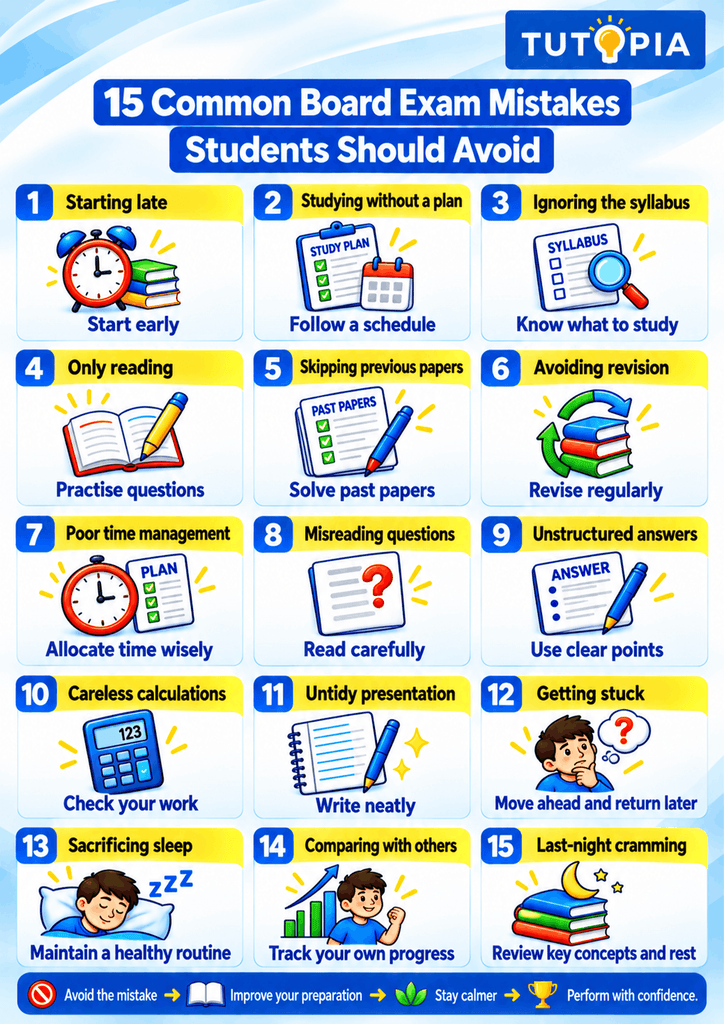
- Start preparing well in advance.
- Have a practical study timetable.
- Understand your syllabus.
- Practise rather than read only.
- Revise regularly.
- Work on past year papers.
- Read the question carefully.
- Time management.
- Check your answer.
- Keep your presentation clean.
- If you cannot solve a particular question, move on.
- Get a good sleep and take breaks.
- Think about yourself and not others.
- Organise your examination material in advance.
- Stay calm in case anything goes wrong.
You don’t need to be perfect. All you need to do is make sure you don’t make any mistakes which you can avoid.
How Tutopia Can Help
What about spending several hours preparing for your board exams and forgetting an important formula? That can be rather disappointing, particularly since you invested so much time in preparation. However, the issue might not be related to insufficient effort but to ineffective revision and practice.
This is where Tutopia SWIFT may come into play.
Created specifically for concentrated board exam revision, Tutopia SWIFT assists students in enhancing their preparation and not feeling overwhelmed by the syllabus.
How can Tutopia SWIFT help you avoid certain mistakes in your exam?
- Eliminate last-minute cramming: Develop a more organised revision strategy and do not rush to cover the whole chapter at the very end of your preparation.
- Do not rely on memorisation only: Revisit critical ideas and ensure you understand them well before starting your practice.
- Practice questions before taking the exam: Complete practice questions and tests to evaluate your ability to apply theoretical knowledge in practice.
- Enhance your confidence at the exam time: Practice with exam-like questions regularly to learn how to deal with questions better.
By utilising Tutopia’s video lessons, Mock Tests Online and revision help using SWIFT, one can go through a streamlined process of learning that goes like this:
Learn -> Understand -> Practice -> Revise
Examinations from boards not only depend on how much you have studied but also on how well you have retained and applied your learning.
Do not let any avoidable mistakes take away from your efforts. Start revising smarter with Tutopia SWIFT and enter your board examinations prepared, confident and with your best foot forward.
Final Thoughts
Yes, board exams are essential, but they should not be a cause of constant fear for everyone.
You could have an inefficient day, forget an entire chapter, or get anxious before a test; that doesn’t mean you cannot excel. Identify what did not go right and then make minor adjustments to correct things.
Knowing how to avoid board exam mistakes can help you manage your time better, keep your cool, and walk into the examination room with more confidence.
With the right board exam tips and some patience with yourself, you can get ready much better.
Want some extra help? Tutopia SWIFT can help you study, practice, and revise effectively.